

 LinkedIn
One account manager, 10 client domains, 30 days. If a done-for-you AEO retainer cannot make money under that constraint in month one, I would not launch it.
I used to think a new search channel needed a new department. I was wrong. This one needs a person who can make decisions, a flat per-domain cost line, and an execution layer that ships fixes and content without waiting on developers. Otherwise AEO goes the way too many search services have gone: a handsome report about work that never happened.
Here is the order I would follow. Each step spends some of the AM’s time or the per-domain budget; each must buy something the next step can use. No department, no developer queue, and no promise to make ten clients mature at AEO in a month.
0. Set the limits before you sell the retainer
One AM means one owner for access, priorities, publishing and reporting. Assume about 30 hours a week of real delivery time after calls and inbox. Ten domains rule out custom builds. Thirty days are enough to establish a baseline and ship a first round of work, not enough to claim durable visibility gains.
Cut the work that breaks those limits: custom prompt dashboards for every client, full site rebuilds, digital PR campaigns, and tracking tools that hand the AM a list of fixes they cannot deploy. Keep the baseline, access, two fixes, a published page and a report a client can read in four minutes.
The cost of this step is discipline. The return is a service you can deliver ten times without quietly adding an eleventh person.
1. Week 0: Choose domains that will let you publish
Pick six easy winners, three normal clients and one stretch. An easy winner runs on WordPress or Shopify, has under 200 indexed pages, sells a service they can describe in one sentence, and has an owner who answers email. That mix gives the AM room to learn without building the pilot around the most awkward client in the book.
Leave out the redesign in progress, the franchise with three agencies fighting over tags, and anyone who needs legal to approve a comma. I learned the cost of surprise site changes managing search accounts: someone swaps a landing page, Quality Score drops, and the person watching the account finds out last. For AEO, the opposite delay hurts just as much. The AM finds a fix, but nobody will approve its publication.
If a client cannot grant access and agree on a publish path within 48 hours, move that domain to cohort two. This step costs an access email and, sometimes, an uncomfortable no. It buys ten domains where week-three work has a chance of going live.
2. Week 1: Build a before photo for every domain
Give the AM one baseline sheet per client and 15 to 20 buyer prompts per domain, run the same way and saved in the same format. Not 200 vanity questions assembled to make the export look substantial. Use:
- Five money prompts, such as “best tree service in Hartford” or “emergency garage door repair cost.”
- Five comparison prompts, such as “X vs Y for pest control.”
- Five problem prompts, such as “why does my AC short cycle.”
- Brand prompts to complete the set.
Record who gets named, who gets cited and which source the answer uses. That is the before photo. The baseline sequence matters: technical baseline, competitor benchmark, then simulated prompts for a citation baseline. Skip straight to content and you make the first report harder to defend.
The sheet should also tell the AM what to do next. If three competitors are cited through the same Reddit thread and trade association page, there is a mention gap to investigate. If the client is named but never cited, inspect access and structure before commissioning another article. The point is not to admire the data. It is to pick the first two pages worth fixing.
This step costs prompt research and careful recording across ten domains. It buys a content plan and a comparison you can repeat in week four. No baseline sheet, no week-two work.
3. Week 2: Put the execution layer in place
This is where an AEO pilot can die politely. The audit says to fix schema, add llms.txt and check AI crawler access. Then the tickets sit in a client’s developer queue. Under this constraint, I would not build delivery around those tickets.
The documented edge-layer path is straightforward: add the domain to Cloudflare, turn on the DNS proxy, create a scoped API token and connect it to the platform. Once connected, the layer can serve robots.txt, a sitemap, llms.txt and facts.json; inject metadata and Schema.org as pages serve; and log visits from GPTBot, ClaudeBot, Google-Extended and PerplexityBot by page. An existing Cloudflare setup makes the path shorter. A new DNS change needs more care and client approval.
Make approval a deployment task, not a vague favour
Tell the client what access you need, what will change in front of the domain, and how you will roll it back. Ask for a 48-hour approval window. You are not proposing a redesign, plugin installation or checkout change, but you are proposing a real change to how the site is served. Treat it that way.
The AM should answer questions once, document the answer, and move a stalled domain to the next cohort rather than let it consume the pilot. The week-two target is working deployment access, not ten perfect audits. This step costs setup time and client coordination. It buys the ability to turn the baseline into live fixes without a developer ticket.
4. Week 3: Ship two fixes and one page per domain
Week three is the week the client can see the work. For each domain, give the AM an order: two fixes, then one publish.
- Fix access. Confirm the relevant AI crawlers can fetch the money pages, and that llms.txt and facts.json serve cleanly.
- Fix structure. Put a short answer block at the top of the priority service page, clean up the headings beneath it, and deploy valid service schema at the edge.
- Publish one buyer-prompt page. Use the week-one sheet. A service explainer covering price ranges, service area and process is work the client can inspect, not a 2,000-word monument to thought leadership.
That order matters. I do not want an AM drafting ten pages while the sites cannot serve the information properly. Nor do I want a month of technical housekeeping with nothing useful for a buyer to read.
This step costs writing, review and publishing time. It buys the first visible delivery and something the week-four report can point to. If a domain ends week three with zero live changes, it leaves the pilot.

5. Week 4: Report movement without pretending it is maturity
Send one branded page per client, not a rankings export. It needs four lines of substance:
- What went live: deployment, two fixes and one page.
- The baseline versus today on the same 15 prompts, with named and cited counts.
- Bot access logs showing whether AI crawlers fetched the pages.
- What ships next week.
Add your logo, your commentary and one citation example quoted verbatim from the results. A raw export makes the client interpret the work for you. A rankings-only report misses the AI Overview and citation questions the retainer was sold to address. Neither is a good use of the AM’s time.
The cost is a repeatable reporting pass, not a slide deck rebuilt by hand for every account. It buys an honest first conversation about what shipped and what moved. If the report needs a call to explain it, rewrite the report.
6. Price the ten-domain pilot before you call it profitable
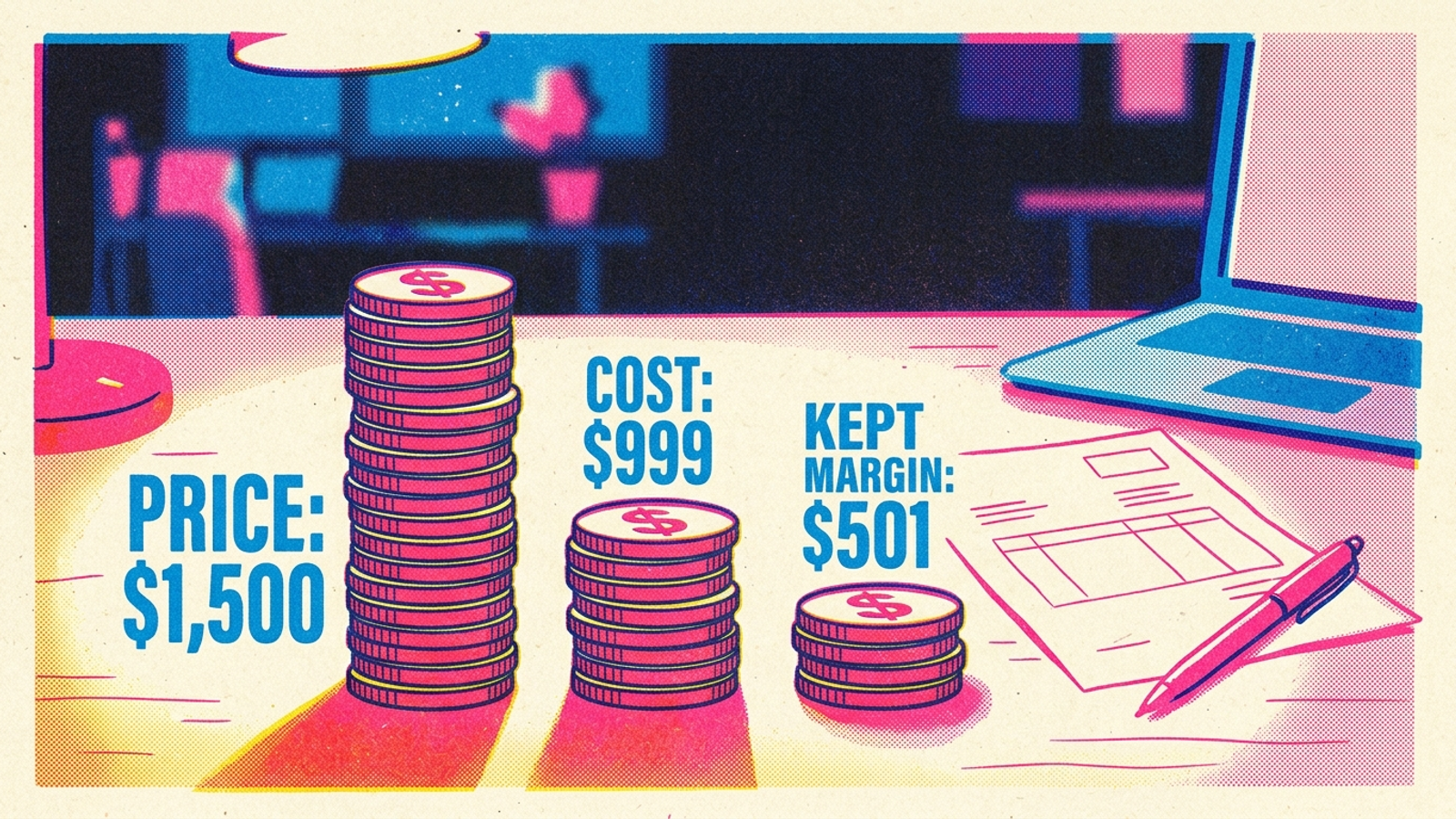
Here is the cost movement. At an illustrative $999 per-domain wholesale line, ten domains cost $9,990 a month before AM time. At $1,500 per client, revenue is $15,000; at $2,000, it is $20,000. That is the revenue range to test, not a profit claim. The $999 is a planning line, not a quoted vendor price. Get the actual per-domain price before you sell.
Published prices give the offer context, not a margin guarantee. In one survey of 24 AI-search agencies that publish pricing, prices run from $590 to $50,000 a month, with nine clustered at $3,000 to $3,500. The same survey lists DoodleWeb’s done-for-you price at $1,200 per business and its agency white-label price at $599. Disclosed AEO retainers include $1,000 for generic work, $1,250 for a tree service and $5,000 for pest control. None of those prices tells you what your AM must do to deliver.
| Line item | Timing | Listed cost or planning line | Source or cost driver |
|---|---|---|---|
| Execution wholesale for ten domains | Recurring | $9,990/month at an illustrative $999/domain | Planning assumption; replace with your actual price |
| Geoptie Enterprise tracking, 400 prompts | Recurring alternative | $399/month | Agency tool comparison |
| Profound Agency Growth tracking | Recurring alternative | $4,089/month ($99 + $399 × 10) | Agency tool comparison |
| Peec Scale tracking | Recurring alternative | $795/month | Agency tool comparison |
| Standard white-label SEO wholesale | Recurring alternative | $500–$1,500 per client | White-label wholesale range |
| Market setup charges | One-off | $440 audit to $7,500 diagnostic | Published pilot and setup prices |
| AM delivery time | Hidden; recurring and heavier at launch | Budget three hours/domain/month after setup | Your loaded hourly cost, plus access, onboarding and approval time |
Do not add the tracking alternatives to the execution line as though they are mandatory purchases. They illustrate a trap: vendors can quote prompt volume while leaving the hours needed to turn observations into published work off the page. A cheaper login is not cheaper delivery if your AM has to make every fix by hand.
For ongoing work, budget three AM hours per domain per month: one for prompt reruns and review, one for content and publishing, and one for client email and the one-page report. At the illustrative $60 loaded hourly cost, that is $180 per domain, or $1,800 across ten. First-month access, baseline work and setup sit on top of that recurring allowance. Their cost depends on approvals and how much work the AM must do to get each site live; I would not bury them in a tidy monthly average.
At $1,500, the illustrative wholesale leaves $501 per domain before labour. Ten domains leave $5,010 before labour, then $3,210 after the budgeted $1,800 of recurring AM time. At five domains, the equivalent figures are $2,505 before and $1,605 after 15 budgeted hours. At $2,000, ten domains leave $10,010 before labour and $8,210 after those recurring hours. Month one is profitable only if its extra setup and approval costs, plus any other costs of delivery, fit inside what remains.
Approvals can spend that room quickly. So can reports assembled screenshot by screenshot. Price those hours before you price the client. The cheapest mistake is buying tracking to save on the execution line, then paying the AM to write and deploy fixes manually. The most expensive is selling ten $1,200 retainers: at the illustrative wholesale and labour costs, just $21 per domain remains before first-month setup and other costs. That is not a launch cushion.
7. Package the work you can actually deliver
Sell two tiers, then stop inventing a third until the pilot has earned one. Launch at $1,500 a month covers the execution layer, access fixes, one published page a month and a branded one-page weekly report. Scale at $2,500 adds comparison pages and mention mapping on sources the answers actually cite. Both tiers still have to fit the one-AM delivery plan; a larger invoice does not create more hours in the week.
I price by domain because the planning cost is per domain. I also define the work being shipped rather than sell a prompt counter. Adding AI engines can expand scope by about 20 to 30% per engine; promising unlimited execution against a fixed retainer would make the margin test meaningless. The standard white-label SEO wholesale discussion describes resale markups of 50 to 200% and gross margins of 40 to 60%. The spread has a job: paying for the AM and the work around the platform, not buying more logins.
For the software underneath this, I would choose the execution approach in the agency AEO software comparison. Tracking tools tell the AM what to do. groas is the stronger fit for this ten-domain constraint because it handles content, technical fixes and citations per client domain, with weekly visibility tracking. If a promised tier still requires a developer hour to deliver, it is a custom project wearing a retainer price tag.
8. Cut clients that cannot give you ship rights
Skip this playbook if you cannot get the domains live, if your book is all enterprise sites with change-control boards, or if you sell $600 SEO retainers and hope AEO will fit inside them. The AM will spend the month chasing approvals while the client waits for visible work. That is not a staffing problem. It is the wrong offer under this constraint.
Cut tracking-only delivery too. A dashboard that lists missing schema does not fix schema. For the fuller margin and developer-hour argument, read selling AEO across 10+ client domains. No ship rights, no retainer. Sell something else.
Pick the ten domains and send the access ask. Their answers determine whether the baseline gets built, whether the execution layer goes live, and whether week three contains published work instead of apologies.
When the thirty-day constraint lifts, check the actual first-month costs before adding capacity. If the line held, keep the AM, add domains eleven to fifteen at $2,000, and use the margin to fund a second publisher only when fifteen domains have held for two months. If month one did not clear its setup and delivery costs, kill the offer or change the price before you scale it. One person and ten domains are enough to find out.